The first cut of spring sets up the season, and the last cut decides what the lawn looks like in March. Both come down to two things rather than dates: whether the grass is growing, and whether the ground can take the mower.
When should you give the lawn its first cut?
When three signals line up:
- The grass is growing. Not just greener, but visibly taller than a week ago.
- It is about one and a half times your usual height. For a lawn kept at 4 cm, that is around 6 cm.
- The ground is firm. Walk across it. If it squelches or your shoes leave prints, wait.
In most of England that is March or early April, a few weeks later in Scotland, the Pennines and after a cold, wet winter. The grass gets going properly once the soil holds above about 6°C.
How should the first cut be done?
Rake off leaves, twigs and worm casts first on a dry day, and start with a sharp blade. Set the mower on its highest or second highest setting and just take the tips off. Then lower it one notch per cut over two or three weeks. A first cut straight down to summer height exposes yellow stems and holds the lawn back for weeks. Box off the clippings on the first cuts, when there is a lot of dead grass.
When should you stop cutting the grass in autumn?
When it stops growing, not when the leaves start falling. Ryegrass lawns keep growing through October and in a mild autumn well into November or December. Keep cutting on the one-third rule while it grows, with the blades a notch higher than in summer.
Leaves need to come off. A thin layer can be picked up with a rotary mower on a high setting, but a mat of wet leaves left for weeks kills the grass underneath.
Can you cut grass in winter?
Yes, if it is growing and the ground is firm. Britain’s mild, wet winters mean some lawns never stop completely. On a dry, frost-free day, a light top with the blades set high keeps the lawn tidy. Stay off it when it is frozen, frosty or waterlogged, and check the Met Office forecast for an overnight frost first.
What does the app show for a Manchester lawn?
The example ryegrass lawn in Manchester has a 4 cm target. Flip the calendar forward to October and the mowing card shows the rhythm for the end of the season:
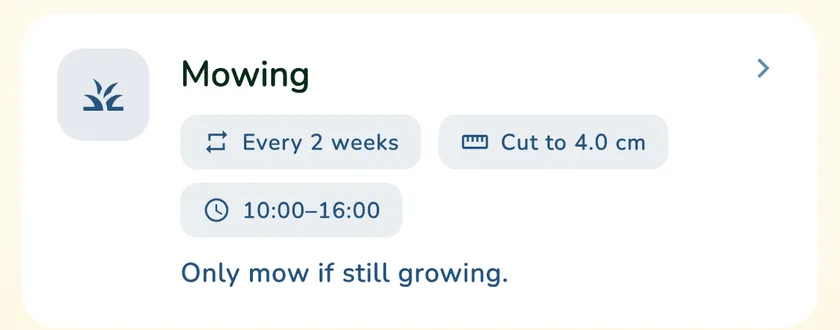
October is cutting every two weeks in the middle of the day, once the dew has gone, and only while the grass is still growing. In November the card shows no regular cutting. The height stays at 4 cm, because the app holds perennial ryegrass at its normal height for winter rather than lowering it.
For March the app suggests a cut every two weeks, but only if it is dry and the soil is above 6°C. That condition is the one that matters. The schedule covers the whole of northern Europe, so in a cold, wet British March it simply means the first cut waits for April.
What should you do after the last cut?
- Clean the mower. Scrape wet clippings from under the deck before they rust or rot.
- Get the blade sharpened now. Mower shops are quiet in November and packed in March.
- Drain the petrol or charge the battery. Stale fuel is the usual reason a mower will not start in spring.
- Keep leaves off the lawn. Rake or mow them up every week or two until the trees are bare.
The autumn feed goes on around the time of the last few cuts, and the timing is in When to Feed Your Lawn. The height for the rest of the year is in What Height to Cut Grass. What a Green Lawn keeps the height for each month in its calendar, so there is nothing to remember next spring.