The first mow of spring sets up the season, and the last one decides how the lawn comes out of the snow. Both are about timing more than dates: the grass needs to be growing, and the ground needs to carry the mower.
When should you mow for the first time in spring?
Three signals, all at once:
- The grass is growing. Green-up alone is not enough. Wait until it is clearly taller than it was a week ago.
- It is about a third past your mowing height. For a lawn you keep at 3 inches, that is around 4 inches.
- The ground is firm. Walk across the lawn. If your shoes sink or leave wet prints, the mower will leave ruts.
In the Chicago area this usually lands in mid to late April, earlier after a warm March and later after a snowy one. Soil temperature is a good early hint: cool-season grass starts growing in earnest once the soil at root depth holds above about 50°F.
How should the first mow be done?
Rake out dead grass and debris first, and start with a sharp blade. Set the deck at your summer height or one notch higher and only take off the tips. A first cut that scalps the lawn back to 2 inches exposes pale crowns and slows green-up for weeks. Bag the clippings on the first mow if the lawn is full of dead winter grass, then mulch from the second mow on.
When should you stop mowing in the fall?
When the grass stops growing, not when the leaves start falling. Cool-season lawns grow well through September and October and often into November, long after the trees are bare. Keep mowing on the one-third rule as long as the lawn needs it. In the northern states, growth usually stops after a few hard frosts in late October or November.
Mowing over leaves is fine as long as the lawn is not buried. A mulching mower chops a light layer into the turf. A thick mat needs raking, because it smothers the grass over winter.
How short should the grass be for winter?
Slightly shorter than summer, but not scalped. For Kentucky bluegrass, bring it down to about 2 to 2.5 inches over the last two or three mows. Tall fescue should stay a bit taller, around 2.5 to 3 inches. Long, floppy grass mats down under snow and is where snow mold starts in spring. Grass cut to the soil loses the leaf that protects its crowns.
What does the app show for a Chicago lawn?
The example bluegrass lawn in Chicago has a 3-inch target. Browse the calendar forward to November and the mowing card shows the step down for winter:
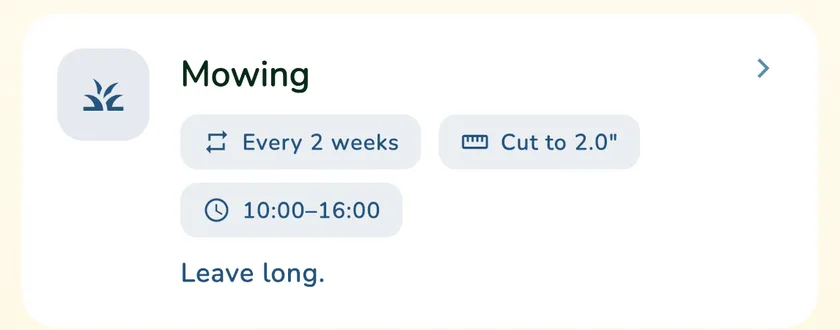
In November the app drops the target to its winter floor for bluegrass, 2 inches, and halfway there in October, about 2.5 inches. For tall fescue the floor is 2.5 inches. Perennial ryegrass and fine fescue are held at their normal height. Mowing every two weeks in the middle of the day matches slow late-fall growth and lets the dew dry first.
Spring is where you need your own eyes. For March the calendar shows weekly mowing at 3 inches. The app uses one schedule for everywhere between roughly the 35th and 50th parallel, from Tennessee to southern Ontario, so for Chicago its February and March suggestions are early. Use the card for the height, and start mowing when the three signals above line up.
What should you do after the last mow?
- Clean the deck. Scrape off wet clippings before they rust the deck over winter.
- Sharpen the blade now. It is one less job in April.
- Run the fuel out or add stabilizer. Old gas is the most common reason a mower will not start in spring.
- Keep leaves off the lawn. One more pass with the mulching mower or a rake before the snow.
The last feed of the year goes on around the same time as the last few mows. The timing is in When to Fertilize Your Lawn, and the height for the rest of the season is in How Short to Mow Grass. What a Green Lawn keeps the mowing height for each month in its calendar, so you do not have to remember the winter height next November.