In a British garden the question is rarely “will it rain?” but “how much, and when?”. Timing a lawn feed is mostly about that: warm enough soil for the grass to use it, enough rain to wash it in, and not so much that it ends up in the drain.
When should you give the first feed of the year?
When the grass is actively growing. Roots start taking up nitrogen properly once the soil is above about 8°C, which in most of England and Wales happens during April. In Scotland, the north of England and after a cold spring, it can be early May.
The easiest rule: if you have mown the lawn once or twice, it is growing, and it will use a feed. Spreading granules on a lawn that is still dormant in March mostly feeds the moss.
How many times a year should you feed your lawn?
For a typical back garden, three feeds is plenty:
| When | What | Why |
|---|---|---|
| April, once the grass is growing | Spring and summer feed, high in nitrogen | Colour and growth after winter |
| Late June or July | A lighter feed, slow-release if possible | Only if the summer is wet and the lawn is green |
| September to early October | Autumn feed, low nitrogen, high potassium | Stronger roots and better resistance to frost and fusarium |
Leave at least three weeks between feeds, and six is better. A second dose on top of one that is still working is the classic way to scorch a lawn.
How do you tell if today is a good day to feed?
Three things decide whether the feed turns into green grass or into run-off:
- Temperature. Grass takes up nitrogen best between 15 and 24°C. Below about 5°C very little happens.
- Rain. Granular feed needs water to dissolve. 5-10 mm over the next day is perfect. If the Met Office is forecasting more than about 20 mm, wait, or it runs off.
- Wind. On a breezy day granules drift off the lawn and onto the borders, and liquid feed goes everywhere.
Here is how that looked for a back garden in Manchester on 17 September 2026:
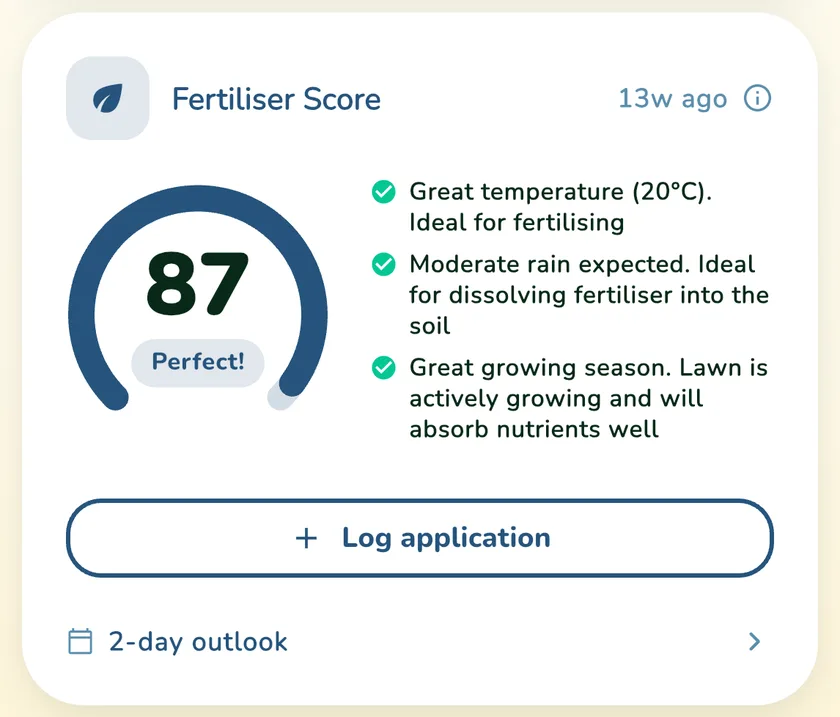
The score is 87 out of 90, perfect. 20°C is ideal for taking up nitrogen, moderate rain will dissolve the granules and wash them down to the roots, and September is the heart of the autumn feeding window. 13 weeks since the last feed means there is no risk of overdoing it. A day like this is worth using, because by late October the soil is too cold for the feed to do much.
What about summer?
In June, July and August the app treats a cool-season lawn as a light-feed lawn. Summer counts for less than spring and autumn, but it no longer blocks a feed: on a mild, damp day it can say go. What stops it is heat and drought. Above about 28°C the score drops sharply, and above 32°C or in a hot, dry spell it says wait, because nitrogen then scorches rather than feeds. A typical British summer is often mild and damp enough for the lawn to keep growing. If you give a summer feed, use a lighter, slow-release product, water it in, and skip it during a dry spell or a hosepipe ban.
When is it too late for an autumn feed?
The autumn feed is the most useful one of the year, because potassium toughens the grass against frost and fusarium patch. Put it down in September or early October while the soil is still warm. By late October the soil has cooled and the grass stops taking it up, and whatever is left washes away over winter.
How much should you put down?
It depends on the nitrogen percentage on the box and the size of the lawn. The sum, with a 145 m² Manchester garden as the example, is in How Much Lawn Feed Do You Need?
What a Green Lawn checks the forecast for your garden every day and scores feeding, overseeding and scarifying, so you can plan the weekend around the one dry, still morning.