The rate printed on a box of lawn feed is a starting point. How much your lawn really needs depends on two things the box does not know: what grass you have and how big the lawn actually is. Work from the nitrogen and you can use any product and still get it right.
How much nitrogen does your lawn need per feed?
Nitrogen is what you are really paying for. Per feed, per square metre:
| Grass | Nitrogen per feed | With NPK 12-3-6 |
|---|---|---|
| Perennial ryegrass (hard-wearing) | 3.5 g/m² | 29.2 g/m² |
| Smooth-stalked meadow-grass | 3.5 g/m² | 29.2 g/m² |
| Mixed or not sure | 3.0 g/m² | 25.0 g/m² |
| Browntop bent | 2.5 g/m² | 20.8 g/m² |
| Creeping red fescue (fine lawn, shade) | 2.0 g/m² | 16.7 g/m² |
| Hard fescue (low-maintenance) | 1.5 g/m² | 12.5 g/m² |
Not sure what you have? Use 3 g. Most British garden lawns are a mix of ryegrass and fescues.
How do you work out grams of feed per m²?
Divide the nitrogen by the percentage on the box, as a decimal:
grams of feed per m² = grams of nitrogen ÷ (N percentage ÷ 100)
With 12-3-6 and a ryegrass lawn: 3.5 ÷ 0.12 = 29.2 g per m². With a 20 percent product it is 3.5 ÷ 0.20 = 17.5 g per m², much less weight for exactly the same nitrogen.
Example: a 145 m² back garden in Manchester
The example lawn in Manchester is perennial ryegrass, drawn on the satellite map in the app at 145 m². With a 12-3-6 lawn feed:
- 3.5 g of nitrogen × 145 m² = 508 g of nitrogen
- 508 g ÷ 0.12 = about 4,230 g, so 4.2 kg of feed
- That is 29.2 g per m²
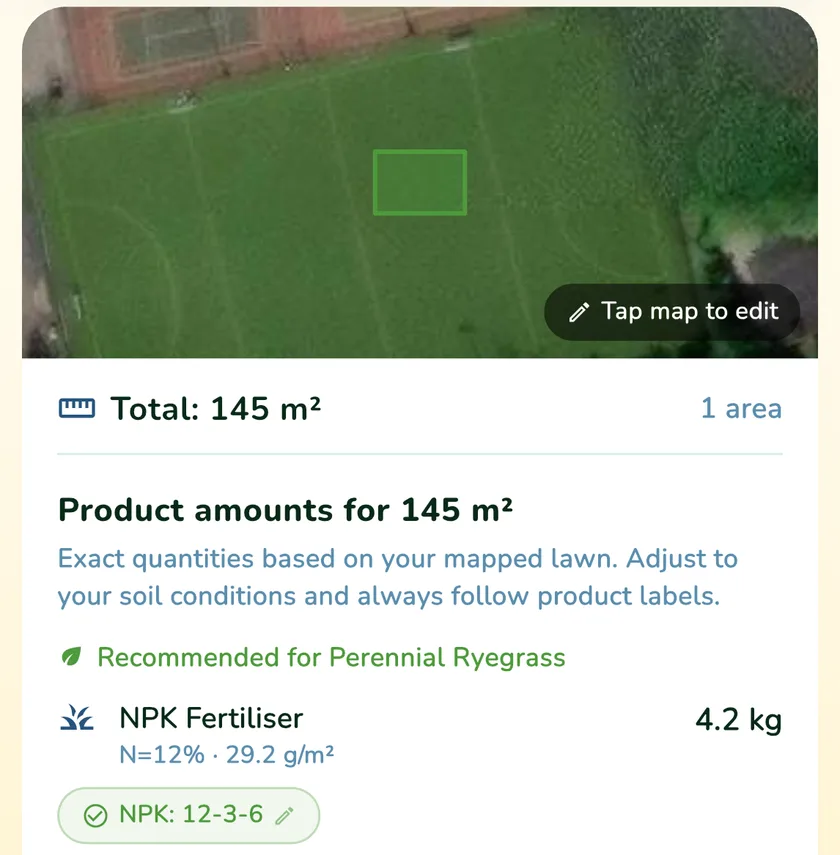
In the app you draw the lawn on a satellite map and it measures the area. Enter the NPK from the box and the amount for the whole lawn appears in kilos. Without an NPK it shows grams of pure nitrogen, so you can do the sum for any product.
How do you measure your lawn without an app?
Split it into rectangles, multiply length by width for each, and add them up. Treat curved edges as triangles or half circles and take off borders that cut in. Being 30 m² out on a 145 m² lawn means a fifth too much feed, so it is worth five minutes with a tape measure.
How do you spread it evenly?
- Weigh out the amount you worked out.
- Put half in the spreader and walk up and down the lawn.
- Add the rest and walk across.
- Sweep any granules off the patio and path back onto the grass.
Scattering by hand nearly always leaves dark green stripes and pale gaps. A cheap push spreader pays for itself.
How often should you apply that amount?
Three or four times a year, at least three weeks and ideally six apart. Which months, and how to pick the day, is in When to Feed Your Lawn.
What a Green Lawn works out the amounts for the lawn you draw and keeps track of when you last fed it, so you never double up.