Canadian bags usually print spreader settings and a coverage in square metres or square feet, and those are a starting point. What your lawn actually needs depends on the grass and the real size of the yard. Work from the nitrogen and any bag will do.
How much nitrogen does your grass need per feeding?
Per feeding, per square metre:
| Grass | Nitrogen per feeding | With 24-0-8 |
|---|---|---|
| Kentucky bluegrass | 3.5 g/m² | 14.6 g/m² |
| Perennial ryegrass | 3.5 g/m² | 14.6 g/m² |
| Mixed or not sure | 3.0 g/m² | 12.5 g/m² |
| Tall fescue | 3.0 g/m² | 12.5 g/m² |
| Fine fescue (shade) | 2.0 g/m² | 8.3 g/m² |
| Hard fescue (low-maintenance) | 1.5 g/m² | 6.3 g/m² |
Not sure what you have? Use 3 g. Most Canadian lawns are a bluegrass, fescue and ryegrass mix.
How do you convert nitrogen to fertilizer?
Divide the nitrogen by the first number on the bag, as a decimal:
grams of fertilizer per m² = grams of nitrogen ÷ (N percentage ÷ 100)
With 24-0-8 on bluegrass: 3.5 ÷ 0.24 = 14.6 g per m². With a 32-0-4 bag: 3.5 ÷ 0.32 = 10.9 g per m². Same nitrogen, quite different weight, which is why “one bag does the yard” is never quite true.
Example: a 380 m² lawn in Toronto
The example lawn in Toronto is Kentucky bluegrass, traced on the satellite map in the app at 380 m². With a 24-0-8 fertilizer:
- 3.5 g of nitrogen × 380 m² = 1.33 kg of nitrogen
- 1.33 kg ÷ 0.24 = 5.5 kg of fertilizer
- That is 14.6 g per m²
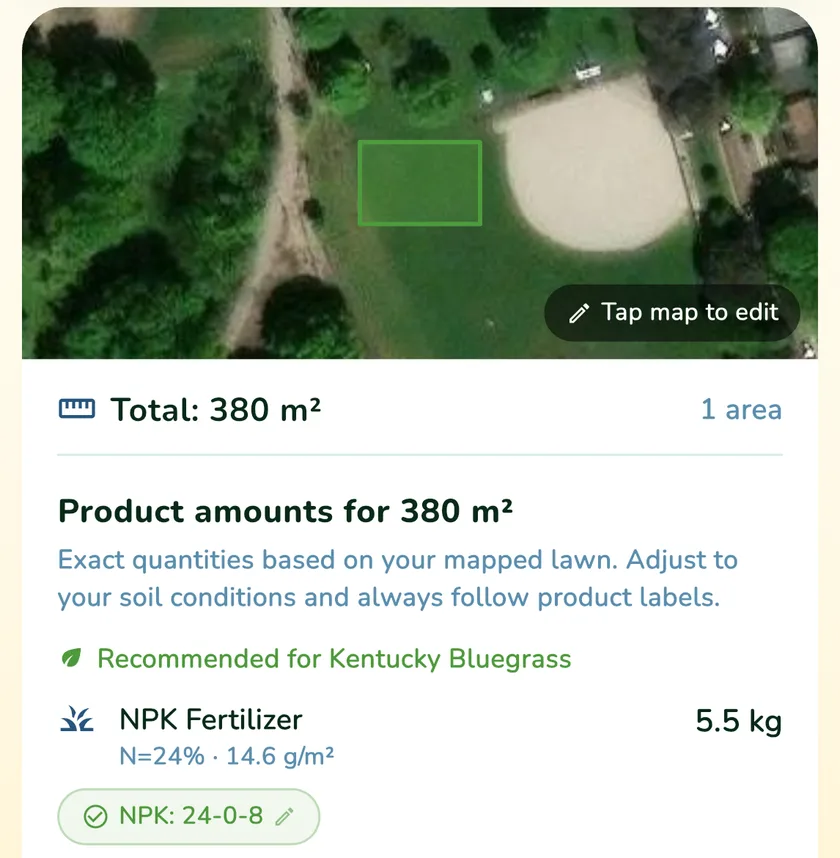
In the app you trace the lawn on a satellite map and it measures the area. Enter the N-P-K from the bag and the amount for the whole lawn appears in kilograms. Without N-P-K it shows the grams of pure nitrogen, so you can do the math for any product.
How do you measure your lawn without an app?
Break it into rectangles, multiply length by width, add them up, and subtract beds and the driveway. Being 100 m² off on a 380 m² lawn means a quarter too much fertilizer, so it is worth ten minutes with a tape measure.
How do you spread it evenly?
- Weigh out the amount you calculated.
- Set the broadcast spreader to half the rate on the bag.
- Walk the lawn in one direction, then across.
- Sweep granules off the driveway and sidewalk back onto the grass.
How often should you apply it?
Three or four times a year, at least three weeks and ideally six apart, with the biggest share in September and October. The timing is in When to Fertilize Your Lawn in Canada.
What a Green Lawn calculates amounts for the lawn you trace and tracks when you last fertilized, so you never double up.