
A warm September afternoon does not wake a couch lawn. Roots and seed respond to the soil, and the soil warms slowly after winter. That is why lawns stay dull through early spring and then take off in October and November.
Which soil temperatures matter for a warm-season lawn?
The What a Green Lawn app treats lawns within about 37 degrees of the equator, which covers Sydney, Brisbane and Perth, as warm-season lawns. For sowing warm-season seed it uses these ranges, with soil at about 10 cm:
| Soil temperature | What happens to seed |
|---|---|
| Below about 12°C | No germination |
| 12 to 18°C | Very slow |
| 18 to 21°C | Germinates steadily |
| 21 to 32°C | Fast, even germination |
| 32 to 35°C | Possible, but keep it well watered |
| Above 35°C | Seed dries out |
Cool-season seed such as ryegrass and tall fescue works the other way: it germinates best at 12 to 18°C, which is why oversowing a couch lawn with rye for winter colour is an autumn job.
When should you scarify and feed?
Scarify a warm-season lawn in spring once it is actively growing and the soil has warmed, so it recovers quickly. Feed at the same point, when new growth shows. The app’s scarifying score uses warm-season soil ranges for these lawns, good from about 18 to 28°C, so it waits until couch and kikuyu are growing strongly.
How do you measure soil temperature?
Push a soil thermometer 5 to 10 cm into the lawn in the morning, when the soil is coolest. Check a sunny spot and a shaded one, and watch the trend for three to five days.
The app estimates soil temperature for your location every day from the air temperature and the month:

For a warm-season lawn the app reads the estimate against warm-season bands: below about 12°C is too cold, and ideal runs from about 18 to 30°C. So a spring morning that a Melbourne ryegrass lawn would call cool shows as dormant for couch or buffalo. It is an estimate, not a measurement, so treat it as a guide.
How do you compare your own readings with the estimate?
Log thermometer readings in the Log tab, and the ground temperature card charts them against the app’s estimate for today:
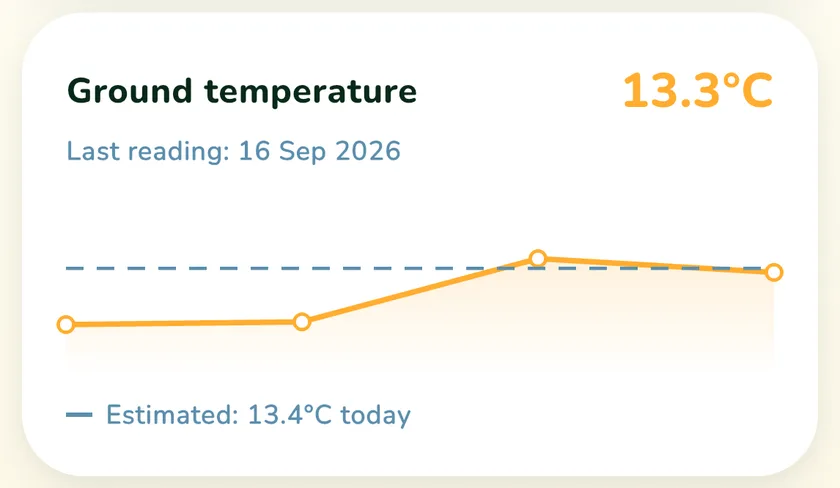
These example readings are model values, not a thermometer in a Sydney lawn, but they show how close or far the estimate can be. If your thermometer differs day after day, trust it.
When is the best time to sow?
For warm-season seed, late spring into summer, once the soil holds at 18°C or more. For cool-season seed, autumn. See when to oversow your lawn and when to scarify your lawn.
The oversowing and scarifying scores in What a Green Lawn use this soil estimate every day, together with rain and the season.