Every bag of seed, fertilizer or lime gives a rate per square foot, and every spreader chart assumes you know your lawn’s size. Most people guess. Ten minutes with a tape measure, or a traced map, takes the guessing out of every product you buy from now on.
How do you measure a lawn by hand?
Split it into shapes you can calculate:
| Shape | Formula | Example |
|---|---|---|
| Rectangle | Length × width | 50 ft × 30 ft = 1,500 sq ft |
| Triangle | ½ × base × height | ½ × 20 ft × 15 ft = 150 sq ft |
| Circle | 3.14 × radius² | 3.14 × 8 ft × 8 ft = 201 sq ft |
Measure along the edges with a 100 ft tape or a measuring wheel. Front and back yards are separate areas; so is the strip between the sidewalk and the street if you treat it.
How do you handle curves, beds and trees?
Draw a rectangle around a curved section and take off the part that is not lawn. Subtract flower beds, patios, the driveway and any mulched ring around trees. Round the total to the nearest 100 sq ft; product rates are not more precise than that.
How much of each product do you then need?
Divide your square footage by 1,000 and multiply by the rate on the bag. A lawn of 5,800 sq ft with a label rate of 3 lb per 1,000 sq ft needs about 17 lb for one application. The same works for seed, lime and moss killer. For fertilizer, the full calculation is in How Much Fertilizer Does Your Lawn Need?
Sod is sold by the square foot and the pallet. Add about 5 percent for cuts and odd corners.
How does measuring on a satellite map work?
You trace the outline of the lawn on an aerial photo, point by point, and the app works out the area. It is quicker than a tape for large or oddly shaped yards and easy to redo when you add a bed.
The example lawn in the app is a Chicago front yard drawn on the map as one area:
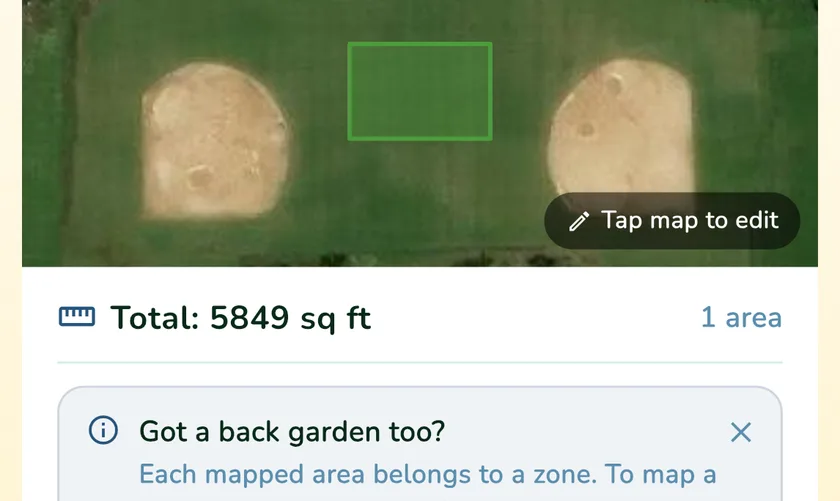
In What a Green Lawn you tap the map to place corners, drag them to adjust, and the area updates as you go, in square meters and square feet. Front and back yards go in as separate zones, and the total feeds the product amounts on the dashboard, so fertilizer, lime, moss killer and seed quantities match your yard. Tree canopy and shadows on the photo can hide the real edge, so check one side with a tape.
How accurate does it need to be?
Within 5 to 10 percent is fine. The bigger risk is being far off: a lawn measured at 3,000 sq ft that is really 5,000 gets 40 percent less fertilizer than intended, and one that is really 2,000 gets 50 percent too much, which is how stripes and burnt patches happen. Measure once, write it down, and remeasure when you change the garden.
What a Green Lawn keeps the mapped area with your lawn and turns it into amounts for each product, so you measure once and never do the math at the spreader again.