Lawn care follows the grass, not the calendar on the wall. Cool-season grasses like Kentucky bluegrass, tall fescue and ryegrass grow hardest in spring and fall and slow down in summer heat. This schedule is written for the northern US, roughly from the Midwest to New England, and shifts a few weeks earlier in the south and later in the far north.
What should you do each month?
| Month | Main jobs |
|---|---|
| January | Stay off frozen or snow-covered grass. Sharpen the mower blade. |
| February | Service the mower. Plan a soil test for spring. |
| March | Rake out debris and matted patches once the lawn dries. |
| April | First mow when growth starts. Crabgrass preventer when soil nears 55°F. |
| May | Mow weekly at about 3 inches. Light first feeding. Spot-treat weeds. |
| June | Raise the mower. Water about 1 inch a week or let the lawn go dormant. |
| July | Mow high, skip fertilizer in heat, check for grub damage. |
| August | Plan fall renovation. Core aerate compacted areas late in the month. |
| September | Overseed, dethatch, feed and control broadleaf weeds. Test the soil. |
| October | Keep mowing, mulch leaves into the lawn, second fall feeding. |
| November | Last mow, final feeding before the ground freezes, drain irrigation. |
| December | Rest. Keep heavy traffic off frozen grass. |
What does the app’s calendar show?
What a Green Lawn builds a week-by-week task list for your lawn, based on its location, grass type and mowing height. For a cool-season lawn in Chicago, the week of September 7 looks like this:
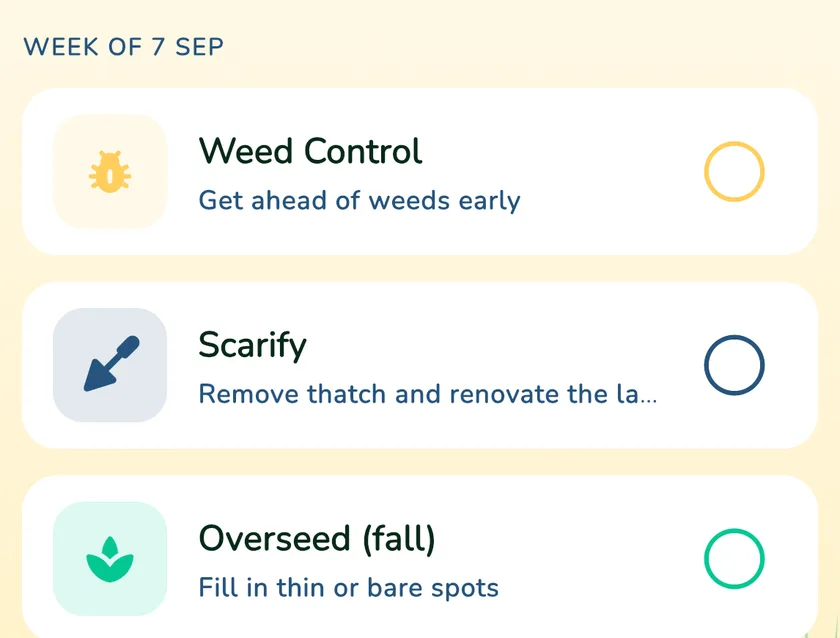
Over the year, the app’s calendar puts feeding tasks in April, May and September to November, weed control at the start of each month from March to October, dethatching in April and September, overseeding in May and September, a spring cleanup in March, leaf clearing in October and a soil pH check in September. December to February are rest months. It also shows a mowing card for each month with frequency, height and the best time of day.
Which weed control should you use?
Pulling and spot-treating beats blanket spraying. Fall is the best time to treat broadleaf weeds like dandelion and clover, because they move the product down to the roots. Follow the label, which is the law for any pesticide, and check local rules: some cities and states restrict lawn pesticides or fertilizer. In Illinois, lawn fertilizer for established lawns must be phosphorus-free unless a soil test shows a need.
How do you adjust the calendar for your region?
Watch the grass and the soil, not the date. A late spring pushes April jobs into May; a warm fall stretches mowing into November. Soil temperature is the best guide for seeding and crabgrass preventer, see soil temperature for lawns. For the first and last cut, see first and last mow of the year, and for feeding, when to fertilize your lawn.
What should you skip?
Summer feeding in drought, dethatching in July heat, and seeding in spring if you can wait until September. Also skip the lime unless a soil test calls for it; many Midwest soils are already neutral or alkaline, see does your lawn need lime.
What a Green Lawn turns this calendar into weekly tasks for your own lawn, with the weather and soil estimate on the same screen.