A lawn that looks thin and brown at the edges in February was often cut too low in November. Mowing height decides how much leaf the grass has to feed itself, how fast the soil dries out and how much room weeds get. Get it right for your grass type and most other lawn problems shrink.
What height suits your grass type?
Australian lawns are almost all warm-season grasses, and each has its own range. Turf suppliers suggest roughly:
| Grass | Mowing height | Notes |
|---|---|---|
| Couch | 1.5 to 3 cm | Tolerates low mowing, needs frequent cuts |
| Zoysia | 2 to 4 cm | Slow growing, mow less often |
| Kikuyu | 2.5 to 5 cm | Grows fast in summer, runs into garden beds |
| Soft leaf buffalo | 4 to 6 cm | Keep at the higher end in shade |
If you do not know the variety, look at the leaf. Wide, soft blades and runners on top of the soil mean buffalo. Fine blades that feel like carpet mean couch or zoysia.
How often do you need to mow to hold that height?
Often enough that no single cut takes more than a third of the leaf. For a buffalo lawn kept at 5 cm, mow when it reaches about 7.5 cm. In January that can be every five to seven days. In July it may be once a month.
Came back from holidays to a jungle? Do not take it straight down. Cut to the highest setting, wait a few days, then go down one notch at a time.
When should you raise the mowing height?
Three times: in a dry heatwave, in shade, and heading into winter. When the Bureau of Meteorology forecast shows a run of hot days above the mid 30s with no rain, go up a notch and leave the clippings on. In autumn, as growth slows, raise the height so the lawn goes into winter with enough leaf to stay green and push out weeds.
What does the app suggest for a Sydney buffalo lawn?
The example lawn is a soft leaf buffalo backyard in Sydney with a 6 cm target. The app does not list buffalo by name, so the lawn is set up as St. Augustine, the closest match in the grass list. The mowing card in the calendar turns that into a height and a rhythm for the month:
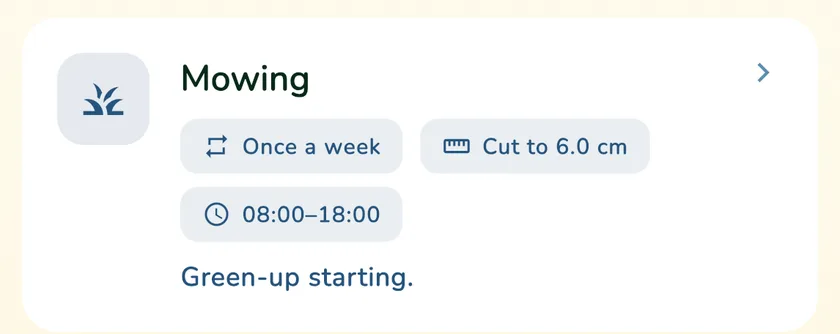
In September the lawn is greening up for spring, so it is weekly mowing at 6 cm. The app flips the seasons for the southern hemisphere, and the height moves through the year. In March it starts raising the target, and by April a St. Augustine lawn is held at no less than 9 cm to protect the runners over winter. On the dashboard, the grass height chart also goes up on hot days: 25 percent above 26°C, 35 percent above 32°C, and 1.5 cm extra when it is hot and no rain is forecast.
Its base height for St. Augustine is 8 cm, taken from American advice for that grass, and the height chart flags a target more than 25 percent away from that, so below 6 cm. A 6 cm buffalo lawn sits right on that line. For an Australian soft leaf buffalo, 6 cm is a sensible height in full sun, and the 9 cm autumn floor is on the cautious side.
What else keeps a lawn looking good after mowing?
- Sharp blades. Blunt blades tear buffalo leaves, and the torn tips go brown. Sharpen at the start of spring.
- Mow dry grass. Wet clippings clump, clog the catcher and leave a ragged cut.
- Change direction. Alternate your pattern each time so runners do not all lie one way.
- Mulch in summer. Short clippings break down quickly and return nitrogen to the soil.
A lawn at the right height uses fertiliser better too. The timing for Sydney is in When to Fertilise Your Lawn. If you want the height for the month without looking it up, What a Green Lawn works it out from your grass, your target and the weather at your address.