Most lawns that struggle in August were mowed too short in June. The height you cut at decides how deep the roots go, how fast the soil dries out and whether crabgrass gets the light it needs to sprout. The good news: it is the one lawn job that costs nothing to get right.
What height should you mow your grass type?
University extension services give ranges, not a single number. Stay in the upper half in summer and in shade:
| Grass | Mowing height | Notes |
|---|---|---|
| Kentucky bluegrass | 2.5 to 3.5 in | 3 in is a safe Midwest default |
| Tall fescue | 3 to 4 in | Thins out if kept under 3 in |
| Perennial ryegrass | 2 to 3 in | Often mixed with bluegrass |
| Fine fescue | 2.5 to 3.5 in | Shade lawns, keep it tall |
| Bermuda | 1 to 2 in | Gets stemmy if left tall |
| Zoysia | 1 to 2 in | Mow often at the low end |
| St. Augustine | 3 to 4 in | Never scalp it |
| Centipede | 1.5 to 2 in | Low-maintenance, slow |
Not sure what you have? Most lawns in the northern half of the country are a bluegrass, ryegrass and fescue mix. Mow those at 3 inches and you will not go far wrong.
How often should you mow to stay at that height?
Often enough that no single cut takes more than a third of the blade. For a 3-inch lawn, that means mowing at about 4.5 inches. In May, when bluegrass grows fastest, that can be every 4 to 5 days. In a dry August it may be every 10 days or more.
Missed a week and the grass is at 6 inches? Do not cut it straight back to 3. Take it to 4 inches, wait a few days, then go down to 3.
Should you raise the mower in summer?
For cool-season grass, yes. Bluegrass and fescue slow down once daytime highs sit in the upper 80s, and every fraction of an inch of extra leaf shades the soil and saves water. Raise the deck half an inch to an inch from late June to the end of August, then bring it back down when nights cool off in September.
Warm-season grass works the other way around. Bermuda and zoysia grow hardest in summer and look best mowed low and often.
What does the app suggest for a Chicago bluegrass lawn?
The example lawn is a Kentucky bluegrass front yard in Chicago, set to a 3-inch target. The mowing card in the calendar turns that into a height and a rhythm for the month:
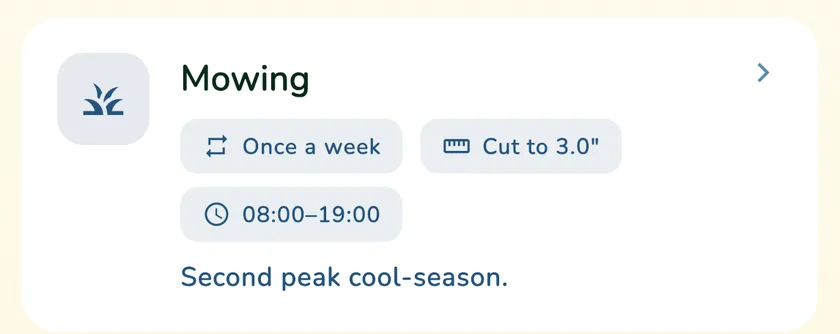
September is the second growth peak for cool-season grass, so it is weekly mowing at the normal 3 inches. The height changes on its own through the year. In June and July the calendar raises the target by 25 percent for bluegrass and tall fescue, so 3 inches becomes about 3.75, with half that raise in May and August. On the dashboard, the grass height chart goes further on hot days: 25 percent up above about 79°F, 35 percent above 90°F, and roughly 0.6 inch extra when it is hot and no rain is on the way.
The app’s own base height for bluegrass is 2.6 inches, and the height chart only flags a target that is more than 25 percent away from that base, so anything under about 1.9 inches or over 3.2 inches. A 3-inch target sits comfortably inside that range. Set the deck to 1.5 inches and the app tells you it is too low for bluegrass.
What else keeps a high cut looking good?
- Sharp blade. A dull blade tears the tips, and they turn white-brown a day later. Sharpen twice a season.
- Leave the clippings. Short clippings break down within days and return nitrogen to the soil.
- Mow dry grass. Wet grass clumps and the cut is ragged.
- Change direction. Alternate stripes each time so the grass does not lean one way.
Height and feeding go together: a lawn mowed at 3 inches uses fertilizer better. The timing for that is in When to Fertilize Your Lawn. If you want the height for the month without looking it up, What a Green Lawn works it out from your grass type, your target and the weather where you live.