Most lawns that struggle in August were mowed too short in June. Height decides how deep the roots go, how fast the soil dries out and whether dandelion and crabgrass seedlings get the light they need. With cosmetic pesticides restricted in Ontario and several other provinces, mowing height is also your best weed control.
What height should you mow your lawn?
Most lawns from Ontario to the Prairies are a mix of Kentucky bluegrass, creeping red fescue and perennial ryegrass. The height depends mostly on the grass and the light:
| Lawn | Mowing height | Notes |
|---|---|---|
| Kentucky bluegrass mix, full sun | 6 to 8 cm (2.5 to 3 in) | 7 cm is a safe default |
| Shady lawn, fescue mix | 7 to 9 cm (3 to 3.5 in) | More leaf to catch light |
| Tall fescue | 7 to 9 cm (3 to 3.5 in) | Thins out if kept short |
| Newly seeded lawn, first cuts | 8 cm | Only when the grass reaches 10 cm |
Not sure what you have? Mow at 7 cm and you will be fine almost anywhere in southern Canada.
How often should you mow?
Often enough that no single cut takes more than a third of the blade. For a 7 cm lawn, that means mowing at about 10 cm. In late May and June, that can be every 4 to 5 days. In a dry August, it can be every 10 days or longer.
Back from the cottage and the grass is at 15 cm? Take it to 10 cm first, wait a few days, then go down to 7.
Should you raise the mower in summer?
Yes. Cool-season grasses slow down when daytime highs stay in the upper 20s. Every centimetre of extra leaf shades the soil and saves water. Raise the deck 1 to 2 cm from late June to the end of August, and lower it again when the nights cool off in September. If Environment Canada has a heat warning out and the lawn is already dry, skip the mowing that week altogether.
What does the app suggest for a Toronto lawn?
The example lawn is a Kentucky bluegrass front lawn in Toronto, with a 6.5 cm target. The mowing card in the calendar turns that into a height and a rhythm for the month:
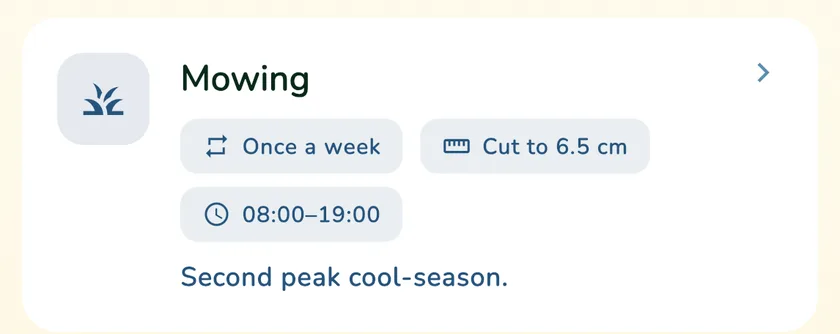
September is the second growth peak for cool-season grass, so it is weekly mowing at the normal 6.5 cm. The height moves on its own through the year. In June and July the calendar raises the target by 25 percent for bluegrass, so 6.5 cm becomes about 8 cm, with half that raise in May and August. In November it drops to a 5 cm winter height for bluegrass. On the dashboard, the grass height chart goes further on hot days: 25 percent up above 26°C, 35 percent above 32°C, and 1.5 cm extra when it is hot and no rain is on the way.
The app’s base height for Kentucky bluegrass is 6.5 cm, so this lawn matches it and the chart shows no warning. Set a target far below that and the app points it out.
What else keeps a tall lawn looking good?
- Sharp blade. A dull blade shreds the tips, which turn white-brown the next day. Sharpen it in spring and midsummer.
- Leave the clippings. They break down in days and return nitrogen to the soil.
- Mow dry grass. Wet clippings clump and the cut is uneven.
- Change direction. Alternate your pattern so the grass stands up straight.
A lawn at the right height uses fertilizer better too. The timing is in When to Fertilize Your Lawn in Canada. If you want the height for the month without looking it up, What a Green Lawn works it out from your grass type, your target and the weather where you live.