Lime only fixes acidic soil, and a lot of Canadian lawns are not acidic. Before you buy a bag, find out what your soil actually is.
What soil pH does grass like?
Kentucky bluegrass, perennial ryegrass and tall fescue grow best between 6.0 and 7.0. Fine fescues tolerate more acidic soil. Below about 6.0, nutrients are harder for roots to use and grass thins. Above about 7.5, iron becomes harder to take up and lawns can yellow even when fed.
Where are Canadian soils acidic?
Rain leaches calcium out of soil over time, so wet regions tend to be acidic: coastal British Columbia, the Maritimes and parts of Quebec and northern Ontario. The Prairies and much of southern Ontario sit on limestone or dry, alkaline soils and never need lime.
How do you test soil pH?
Take 10 to 15 small cores from across the lawn, 5 to 10 cm deep, mix them and send a cup to a soil testing lab. The report gives the pH and, if needed, a lime or sulfur rate. Home kits and probe meters are fine for a rough check.
What a Green Lawn charts the readings you log and flags anything outside 6.0 to 7.0:
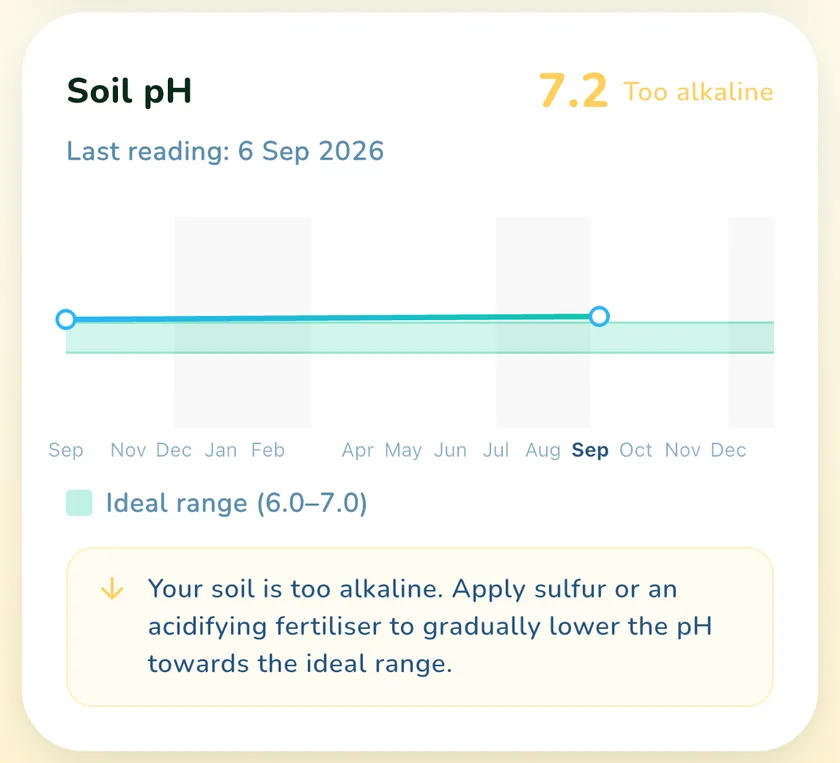
The card appears once you have logged at least two pH readings in the Log tab. Below 6.0 it suggests garden lime; above 7.0, as in this Toronto example, it suggests sulfur or an acidifying fertilizer.
How much lime does a lawn need?
It depends on your soil type and how far the pH must move. Clay needs more lime than sand to shift the same amount, so use the lab’s rate and split large corrections between fall and spring.
The app’s amounts card shows garden lime at one flat rate for your mapped lawn:
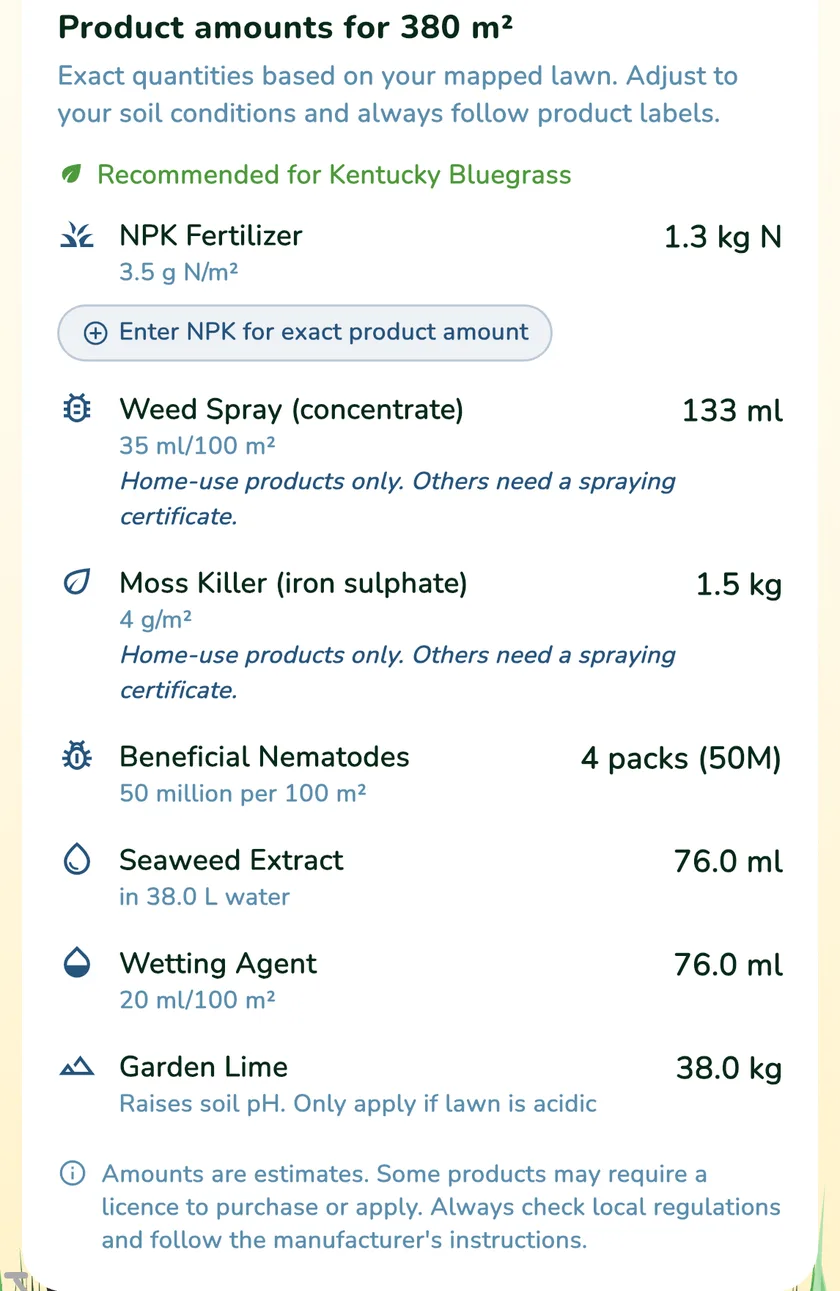
That is 100 g/m², about 20 lbs per 1,000 sq ft, one maintenance application rather than a rate scaled to your soil. The line only shows while your soil is acidic or untested: once you log a pH of 6.0 or higher, the card drops it. The Toronto example at pH 7.2 should get no lime at all.
When is the best time to lime a lawn?
Fall, before the ground freezes, so the lime has winter to work. Early spring, once the snow is gone and the soil has firmed up, works too. Spreading after core aeration gets more lime into the root zone. Keep it a couple of weeks apart from fertilizer.
What if your soil pH is too high?
Elemental sulfur lowers pH, slowly and only a little each year. On alkaline soil, yellowing grass often responds faster to an iron product than to a pH fix. Moss is rarely a lime problem; see moss in your lawn. To get the area right before you buy, see how to measure your lawn.
Log each soil test in What a Green Lawn, and the pH card shows whether your lime or sulfur is moving the number.