Every spring the garden centres at Canadian Tire and Home Depot fill up with lawn fertilizer, and most of it goes down in April. For a Canadian lawn that is the least useful feeding of the year. The ones that count happen in the fall, when most people have stopped thinking about the lawn.
When should you fertilize a Canadian lawn?
Almost every lawn in Canada is cool-season grass: Kentucky bluegrass, fine fescue and perennial ryegrass. They grow in two bursts, spring and fall, and do the most important work in the fall.
| When | Why | How much |
|---|---|---|
| Mid to late May, around Victoria Day | Grass is growing and the soil has warmed | Light, slow-release |
| Late August to mid-September, around Labour Day | Warm soil and cool nights. Roots rebuild after summer | Full rate |
| October, before the ground freezes | Last feeding. Roots keep storing food after the top stops growing | Full rate |
On the Prairies and in northern Ontario, shift everything two to three weeks: spring feeding in early June, the last fall feeding in early October. In Vancouver and Victoria, the season runs a few weeks longer at both ends.
Why not fertilize in April?
Because the soil is still cold. Grass roots take up very little nitrogen until the soil is above about 8°C, and in most of the country that is not until May. Fertilizer on cold ground either sits there or runs off with the spring melt and rain into storm drains and lakes. Wait until you have mowed once or twice.
How do you pick the right day?
The month gets you close. The day decides whether it works:
- Temperature. Bluegrass and fescue take up nitrogen best at 15-24°C. Below about 5°C almost nothing happens.
- Rain. Granular fertilizer needs water to dissolve. 5-10 mm in the next day is ideal. More than about 20 mm coming, or a thunderstorm, means wait. No rain means you water it in.
- Time since the last feeding. Under three weeks is too soon.
Here is a Kentucky bluegrass lawn in Toronto on September 17, 2026:
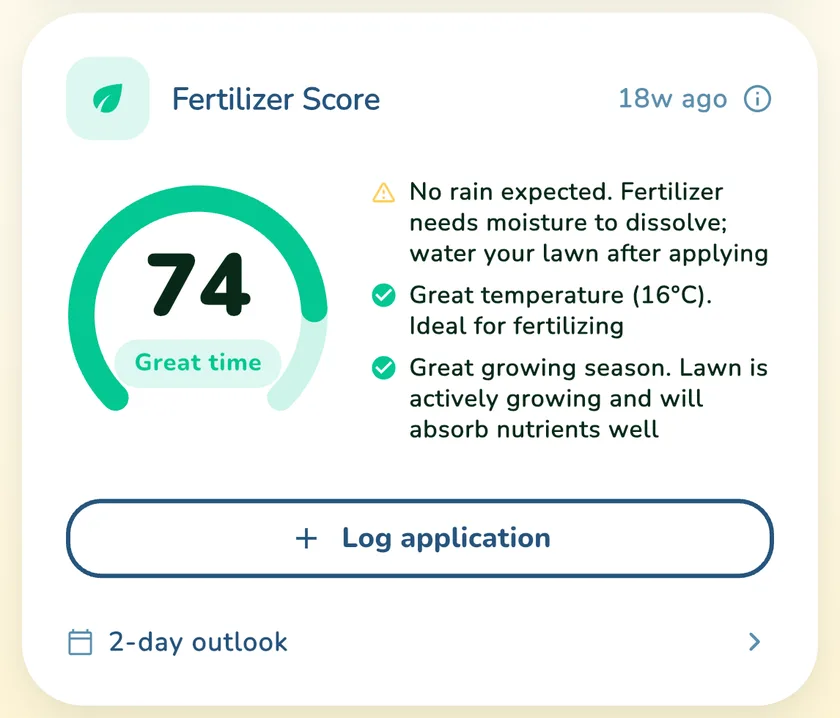
The score is 74, a great time. It is 16°C, in the range where bluegrass uses nitrogen well, it is the middle of the fall feeding window, and it has been 18 weeks since the May feeding. The only thing missing is rain, so the app says to water the lawn after you spread. Put down about 5 mm with a sprinkler within a day.
What about weed and feed?
In Ontario, Quebec and most of Atlantic Canada, cosmetic pesticide bans mean combined weed and feed products are off the shelves. Plain lawn fertilizer is fine. The best weed control is a thick lawn, which is exactly what the fall feedings build.
Most lawn fertilizer sold in Canada is also phosphorus-free, like 24-0-8 or 32-0-4. Unless you are seeding a new lawn, that zero in the middle is what you want.
When is it too late in the fall?
When the ground starts to freeze. The last feeding should go down while the grass is still green, even if it is no longer growing much. In southern Ontario that is usually into November, on the Prairies usually October. Fertilizer on frozen ground is simply washed away in the spring melt.
How much should you use?
It depends on the nitrogen percentage on the bag and the size of your lawn. The calculation, with a 380 m² Toronto lawn as the example, is in How Much Fertilizer Does Your Lawn Need?
What a Green Lawn checks the forecast for your address every day and scores fertilizing, overseeding and dethatching, so you know which fall weekend is worth it.