Most lawn problems are not about the wrong product. They are about timing, and timing depends on remembering what you did and when. A lawn diary takes a minute per job and saves you from doubling up on a spring feed or forgetting the autumn one.
What should you record?
The date and job every time, plus the details you need for the next decision:
| Job | Record | What you use it for |
|---|---|---|
| Fertiliser | Product, NPK, kilos | When the next feed is due, how much nitrogen went down |
| Mowing | Cutting height | Spotting whether you cut too low in summer heat |
| Scarifying | Tines or blades | How hard the lawn was worked |
| Sowing | Seed type, rate | Which seed actually took |
| Wetting agent | Product and date | When water starts running off again |
| Lime and pH | pH reading, kilos | Whether the pH moved |
The fertiliser line matters most. If the diary says 10 April, you know the lawn went through winter on that autumn feed and the spring feed is due once it is growing again.
What a lawn care diary looks like in the app
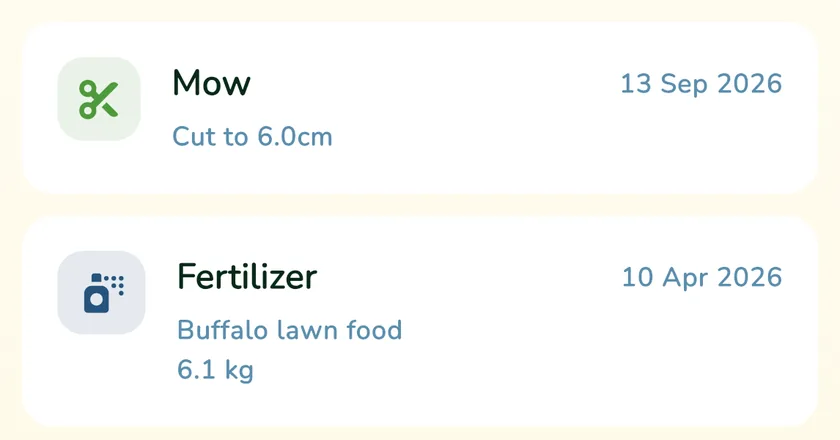
Here is the log for the example buffalo lawn in Sydney: a mow at 6 cm and 6.1 kg of buffalo lawn food on 10 April.
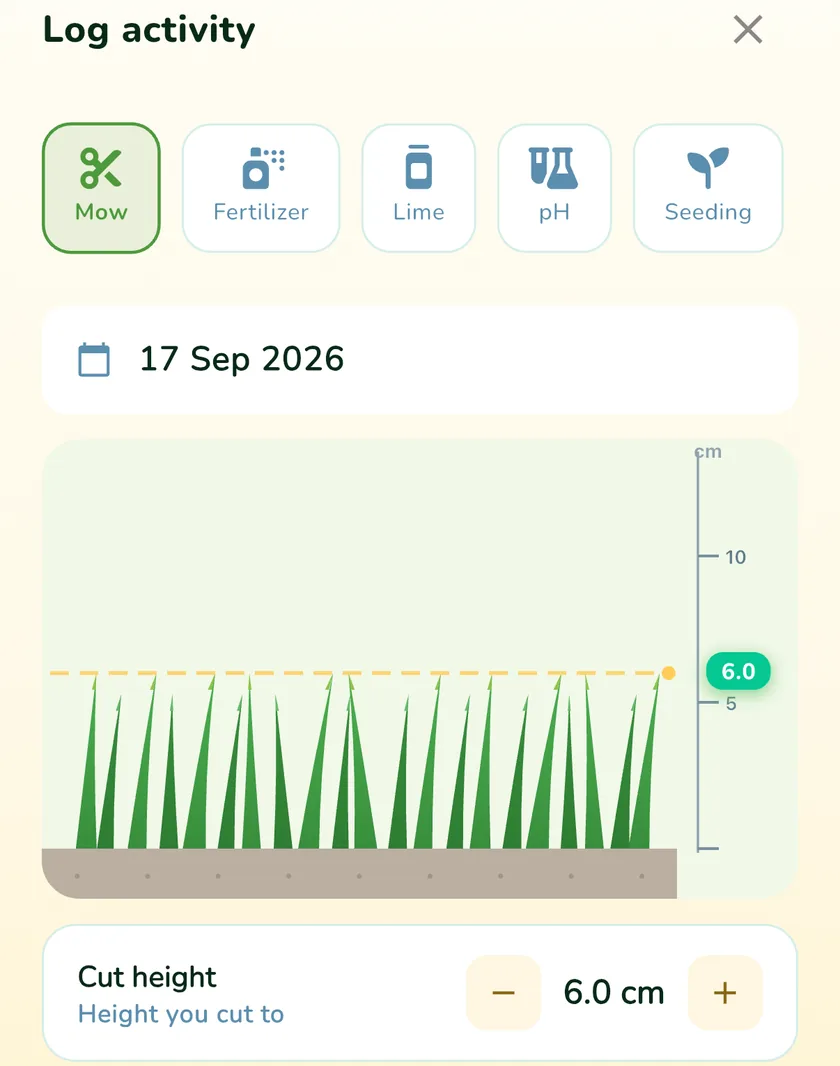
To add an entry you choose the job at the top: mow, fertiliser, lime, pH, seeding, scarify, aerate, seaweed, wetting agent, iron sulphate and ground temperature. For mowing you set the cutting height on a scale that shows how much leaf you leave.
What does the app do with the log?
The log feeds straight into the advice:
- Weeks since the last feed shows on the Fertilizer Score, for example “23w ago”. Under three weeks, the app says don’t apply, whatever the weather.
- Recent activity sits on the dashboard, so the last few jobs are visible at a glance.
- Money spent adds up the cost from every entry where you filled it in.
- pH over time is drawn as a graph, so you can see whether lime or sulphur is working.
So in spring you can open the app and see that the last feed was in April, and whether today is a good day for the next one.
What can a year of notes tell you?
After a year, patterns show up:
- The lawn browned off in the January you mowed buffalo at 3 cm, and held up the next summer at 6 cm.
- The couch seed sown in early September barely came up, while the batch in November filled in within three weeks.
- The early September feed did nothing visible and the one in October did. Soil warmth, not the calendar, was the difference.
When your grass is warm enough to use a feed is covered in When to Fertilise Your Lawn.
What a Green Lawn has the lawn diary built in and combines it with your local forecast to tell you when the next job is worth doing.