A Canadian lawn season is short. Between the snow melting and the ground freezing again, you get roughly six months, and the two feedings that matter most fall in the last three. That is exactly when people lose track of what they did back in May.
What should you track?
The date and task every time, plus what you need for the next decision:
| Task | What to log | What you use it for |
|---|---|---|
| Fertilizer | Product, N-P-K, kilograms | When the next feeding is due, how much nitrogen went down |
| Mowing | Cutting height | Spotting whether you cut too short in July heat |
| Dethatching | Tines or blades | How hard the lawn was worked |
| Aeration | Date | Pairing it with overseeding next time |
| Seeding | Seed mix, rate | Which mix actually filled in |
| Lime and pH | Soil test result, kilograms of lime | Whether the pH moved |
Fertilizer is the line that matters most. If your log says May 18, you know the lawn has gone all summer without food and the Labour Day feeding is due.
What a lawn care log looks like in the app
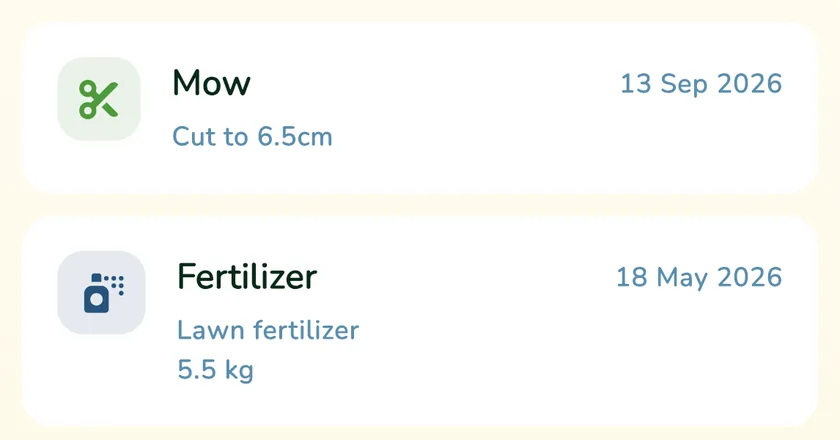
Here is the log for the example lawn in Toronto: a mow at 6.5 cm and 5.5 kg of lawn fertilizer on May 18.
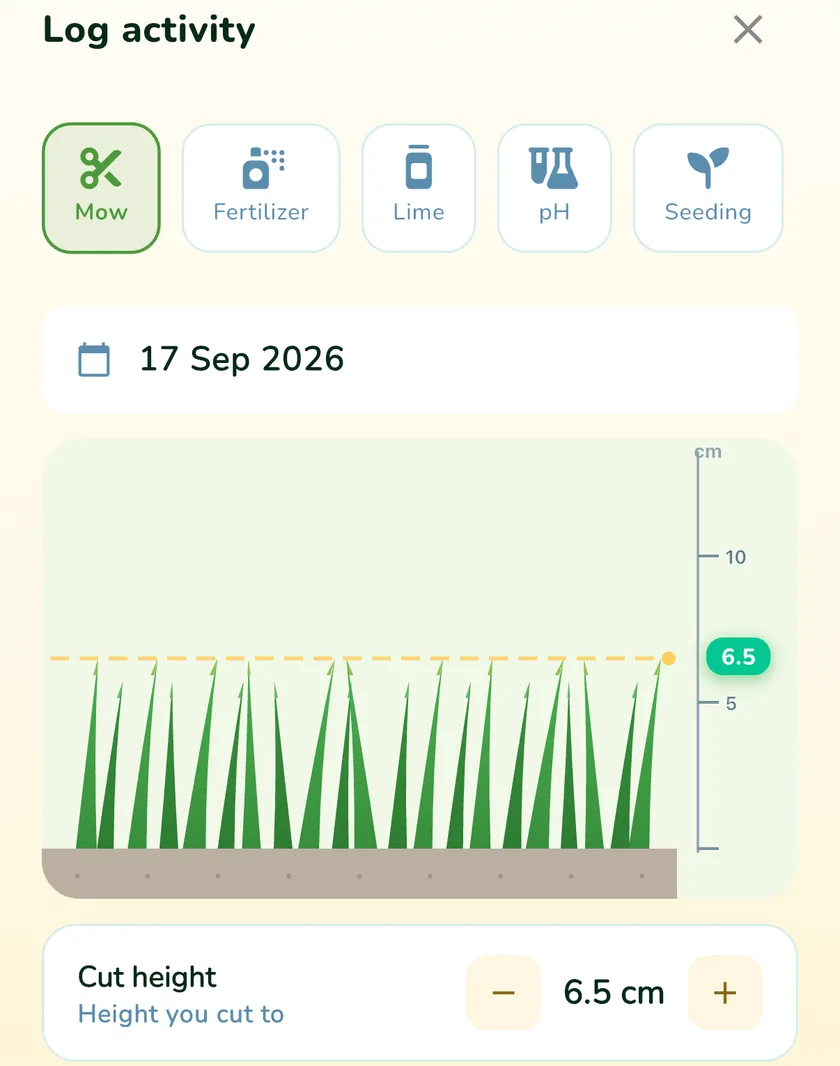
To add an entry you pick the task at the top: mow, fertilizer, lime, pH, seeding, scarify (dethatch), aerate, seaweed, wetting agent, iron sulphate and ground temp. For mowing you set the cutting height on a scale that shows how much grass you leave.
What does the app do with your log?
In the app the log feeds straight into the advice:
- Weeks since the last feeding shows on the Fertilizer Score, like “17w ago”. Under three weeks, the app says don’t apply, whatever the weather.
- Recent activity sits on the dashboard, so the last few jobs are visible at a glance.
- Money spent adds up the cost from every entry where you filled it in.
- pH over time is drawn as a graph, so you can see whether lime is working.
So on the Labour Day weekend you can open the app and see whether the lawn is due, without trying to remember what happened before the long weekend in May.
What can a season of logs tell you?
After a year or two, patterns show up:
- The lawn browned in the July you mowed at 5 cm and stayed green the next summer at 7.
- The May overseeding barely came up, while the late August one filled in within a month.
- The April fertilizer made no visible difference, and the one in late May did. Soil temperature, not the calendar, was the reason.
When the soil is warm enough and when to wait is covered in When to Fertilize Your Lawn in Canada.
What a Green Lawn has the lawn log built in and combines it with your local forecast to tell you when the next job is worth doing.