
In Calgary and Edmonton, “power raking” is practically a spring ritual, and in Ontario the rental counters get busy in April too. It works, but it is also the roughest thing you can do to a lawn, and done too early in a Canadian spring it does more damage than good.
Does your lawn need dethatching at all?
Thatch is the layer of dead stems and roots between the green blades and the soil. A thin layer is healthy. Once it is thicker than about 1.5 cm, it blocks water and fertilizer and makes the lawn feel spongy.
Cut a wedge out with a trowel and look at the side. Kentucky bluegrass lawns, which are most lawns in Canada, build thatch over the years. Fescue-heavy lawns rarely do. If the soil under the thatch is hard clay, core aeration will do more for you than a power rake.
When is the best time to dethatch?
When the grass is growing fast enough to fill in within three to four weeks:
| When | Pros | Cons |
|---|---|---|
| Late May to early June | Whole season ahead to recover | Weeds germinate in the gaps; summer heat follows |
| Late August to mid-September | Warm soil, cool air, perfect for overseeding | Deadline before frost, especially on the Prairies |
Avoid April on half-thawed or saturated soil: the machine tears up turf and roots that have not started growing. A gentle rake to lift dead grass and snow mould is enough then. Skip July and August heat too.
What should the soil be like?
Slightly moist and firm. Too wet and the blades rip out chunks of turf. Too dry and they bounce and shred grass that is already stressed. If a screwdriver slides in and comes out clean, you are set.
Here is a bluegrass lawn in Toronto:
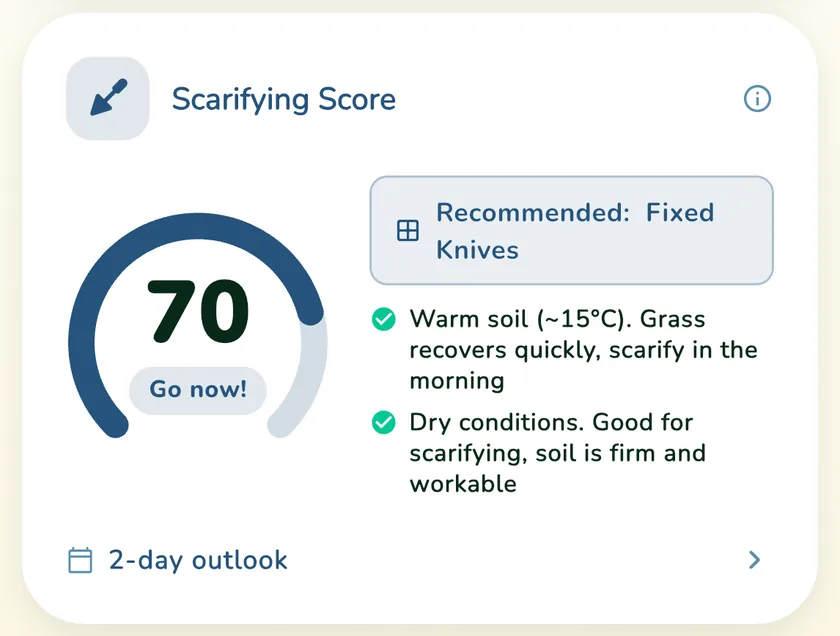
The app calls it scarifying, which is the British name for the same job. It scores 70 out of 90, go now: the soil is about 15°C, so the grass recovers quickly, and conditions are dry and firm, which is ideal for clean cutting. Because it is September and the grass is strong after summer, it recommends fixed knives. In early spring, or when the soil is below about 13°C, it recommends gentler spring tines instead.
Spring tines or fixed blades?
| Tool | What it does | When |
|---|---|---|
| Spring tines (tine dethatcher, rake) | Lifts dead grass and loose thatch, barely touches soil | Early season, light thatch, soil under about 13°C |
| Fixed blades (power rake, verticutter) | Cuts through thatch into the soil surface | Late spring and early fall, thick thatch |
Most rental power rakes from Home Depot or a local rental shop have adjustable blade depth. Start high and lower it one notch at a time until the blades just scratch the soil.
What do you do after dethatching?
- Rake up the thatch. A typical suburban lawn fills several yard waste bags.
- Overseed the thin areas. See When to Overseed Your Lawn in Canada.
- Fertilize to push recovery.
- Water if there is no rain in the first week.
What a Green Lawn checks soil temperature and moisture for your address and scores dethatching, overseeding and fertilizing every day, so the rental power rake does not end up on a soggy lawn.